Trump Hails India’s 7% Growth, Challenges US Rate Policy
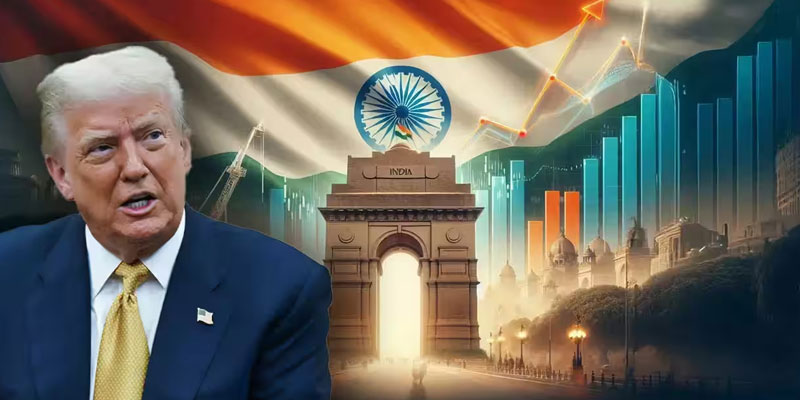
US President Donald Trump has hailed India's impressive 7 per cent economic growth and relatively lower borrowing costs, using the country's performance to question the US Federal Reserve's monetary policy. He argued that if India could achieve such growth with lower interest rates, the United States should be capable of expanding at an extraordinary 14–20 per cent annually if borrowing costs were reduced. While his remarks highlight India's growing economic strength, they also raise questions about the relationship between interest rates, inflation and sustainable economic expansion.
Trump Questions Federal Reserve’s Interest Rate Policy
Speaking at a White House press briefing on November 20, with Vice President JD Vance and Secretary of State Marco Rubio alongside him, Trump criticised the Federal Reserve for what he described as politically influenced decisions on interest rates.
Accusing the central bank of raising borrowing costs even when economic indicators were strong, he maintained that the United States should have the world's lowest interest rates to encourage investment, business expansion and consumer spending.
Referring to India, Trump remarked: "If you look at India, they have low interest rates, and they have a 7 per cent GDP. We would have a 14, 15, or maybe even a 20 per cent GDP."
His comments followed his Asia trip and reflected his continuing push for monetary easing to accelerate American economic growth.
India’s Growth Performance: What the Numbers Reveal
India's economic performance provides a strong reference point for Trump's argument. The Reserve Bank of India has projected GDP growth of 7.1 per cent for the financial year ending March 2027, following an impressive 7.8 per cent expansion in the April–June quarter.
However, India's monetary policy is not entirely characterised by low borrowing costs. The RBI raised its benchmark repo rate by 25 basis points to 5.50 per cent in October, reflecting concerns over inflationary pressures.
India's growth is supported by domestic consumption, infrastructure investment, expanding services, manufacturing activity and a favourable demographic profile.
Why America Cannot Simply Target 20% Growth
Although lower interest rates can stimulate borrowing, investment and consumption, they cannot independently deliver extraordinary economic expansion.
The US is a mature, services-driven economy with established infrastructure and a relatively developed capital market. Achieving 14–20 per cent annual growth would require unprecedented productivity improvements, substantial investment and expanded productive capacity.
Excessive monetary stimulus could instead fuel inflation, asset bubbles and financial instability.
Monetary Policy: The Political and Economic Divide
The Federal Reserve must balance maximum employment with price stability. Its reported policy rate stood at 3.75–4.00 per cent following its September decision, making Trump's demand for substantially cheaper credit a significant policy debate.
India’s Growth Is the Benchmark, not a Shortcut
India's 7 per cent growth demonstrates its rising economic influence and development potential. However, comparing two economies with different structures and growth trajectories requires caution. Trump's praise recognises India's achievements, but sustainable American growth cannot be engineered through interest-rate reductions alone. Ultimately, productivity, innovation, investment, employment and economic stability—not cheaper money alone—will determine how successfully either nation expands.
(With agency inputs)